What the Orchard Knows: Inside Britain's Heritage Cider Revival
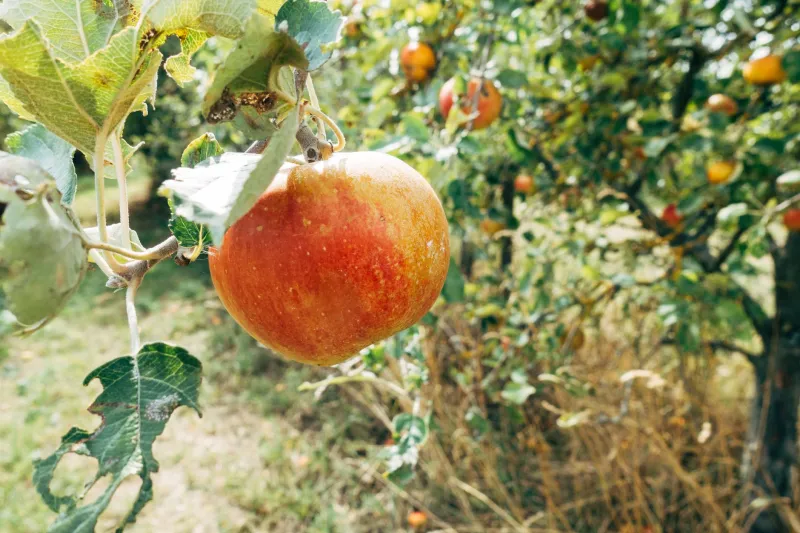
Pour a glass of good farmhouse cider and hold it to the light. The colour alone — whether pale gold, deep amber, or something closer to burnished copper — tells you something. So does the smell, which might carry tannin and blossom, beeswax and damp earth, or a faint sharpness that catches at the back of the throat before the sweetness arrives. Every one of those signals is information. Not just about fermentation or yeast, but about a specific place: a particular valley, a particular soil, trees planted by hands long since gone.
Britain has been making cider for well over a thousand years. It was a staple of rural life, a currency of farm labour, a drink so embedded in the agricultural calendar that orchards were planted as deliberately as fields were ploughed. Then, across the course of the twentieth century, most of it was swept away — by consolidation, by industrial production, by a mass market that decided cider meant fizzy, sweet, and cold. The orchards were grubbed up. The varieties were forgotten. The knowledge of how to ferment them properly came close to dying out entirely.
What is happening now, quietly but with gathering momentum, is something that feels less like a trend and more like a correction.
The Variety Question
To understand the cider revival, you first have to understand the apple situation. Britain is home to something in the region of 2,500 named apple varieties, many of them specific to particular counties or even individual parishes. Of those, a significant proportion were grown specifically for cider — bitter, tannic, high-acid varieties with names like Yarlington Mill, Dabinett, Kingston Black, and Foxwhelp that most people have never encountered because they are entirely unpleasant to eat raw. Their purpose was always the press.
During the mid-twentieth century, as commercial orchards were rationalised and supermarket supply chains demanded uniformity, thousands of these varieties effectively vanished from cultivation. Some survived in neglected corners of old estates. Some were preserved by the efforts of organisations like the Marcher Apple Network in Herefordshire and the National Fruit Collection at Brogdale in Kent. Many were simply lost.
The makers now working to revive heritage cider are, in many cases, doing detective work alongside their farming. They are consulting old county records, visiting farm sales, taking cuttings from gnarled trees in abandoned orchards, and sending samples for DNA analysis to establish exactly what they have found.
"Every old variety we identify and graft back into production is a small victory," says one Herefordshire maker, walking a recently replanted orchard where young trees are staked in rows between the veterans. "Some of these trees are eighty, a hundred years old. The knowledge of what they are was held by one family, sometimes just one person. When that person goes, it's gone. We're in a race, really."
The West Country and the Welsh Marches
The heartland of British cider culture runs roughly from Somerset and Dorset northward through Gloucestershire and into the Welsh Marches — Herefordshire, Monmouthshire, parts of Shropshire. This is apple country in the deepest sense: the landscape shaped by orchards, the soil types suited to specific varieties, the climate providing the slow ripening that concentrates flavour and tannin.
In Somerset, where cider has been made commercially since at least the seventeenth century, a small cluster of producers has spent the past two decades quietly rebuilding what was lost. They are not making the same product as the large national brands — not remotely. They are making still or lightly sparkling farmhouse ciders, often using wild fermentation, that carry the unmistakable character of their specific orchards.
Visit one of these producers during pressing season — October into November, when the air is cold and sharp and the yard smells of crushed apple — and the process looks both ancient and entirely logical. Fruit is gathered, sorted, and milled into pomace. The pomace is pressed, traditionally using a rack-and-cloth press that layers cloth and fruit in a way unchanged for centuries. The juice runs clear and cold into tanks, where it will ferment slowly, sometimes over months, on the natural yeasts present in the fruit and the environment.
The result is a drink of genuine complexity. Not every bottle is the same. Not every year is the same. That variability, which industrial producers have spent decades engineering out of their products, is precisely what makes these ciders interesting.
Microclimate, Soil, and the Sense of Place
One of the more compelling arguments made by heritage cider makers is that their drink expresses terroir — that French concept usually applied to wine — as convincingly as any grape-based product. The idea is not far-fetched. Apple varieties respond to soil and climate in ways that are genuinely measurable. A Yarlington Mill grown on red sandstone in Herefordshire will produce a different flavour profile from the same variety on limestone in Somerset. Altitude, aspect, and rainfall all leave their marks.
This is one reason why the best makers are increasingly reluctant to blend across regions or even across orchards. Single-orchard ciders — analogous to single-vineyard wines — are becoming more common, and the conversations around them are becoming more sophisticated. Drinkers who take the time to explore are discovering that British cider, at its best, is as complex and site-specific as any traditional European fermented drink.
In Wales, where cider's history is perhaps less celebrated but no less genuine, producers in Powys and Carmarthenshire are working with varieties that have barely been documented. The Welsh Marches sit at the edge of what might be called the cider apple zone, and the varieties that developed there over centuries reflect a slightly cooler, wetter climate. The resulting ciders tend toward higher acidity and a more austere character — less immediately approachable than a ripe Somerset blend, but rewarding with attention.
The Knowledge That Must Not Be Lost
Beyond the orchards themselves, what the revival is really rescuing is practical knowledge: how to read an apple for ripeness, how to manage wild fermentation, how to blend varieties to balance tannin and acid and sweetness, how to know when a cider is ready and when it needs more time. This is craft knowledge, accumulated across generations, and it cannot be found in a textbook.
Several of the producers now at the forefront of the movement learned directly from older makers who had kept the flame alive through the lean decades — often in the face of indifference or outright mockery from an industry that had moved on. That transmission of knowledge, person to person, is now being supplemented by more formal efforts: apprenticeship schemes, small-scale training programmes, and documentation projects that are recording methods and varieties before the last living links to traditional practice are gone.
It is, when you think about it, the same story that runs through almost every corner of Britain's rural food culture. The knowledge was always there, held by people who never stopped believing it mattered. What has changed is that more of us are starting to agree with them.
The orchard, it turns out, has been patient. It has been waiting for us to come back.