Salt, Muscle, and Memory: The New Charcutiers Rebuilding Britain's Curing Tradition from the Archives Up
There is a recipe for a Suffolk-cured ham in a handwritten household ledger at a regional archive in Bury St Edmunds. It is dated 1847, and it specifies quantities of salt, brown sugar, and black treacle with the casual precision of someone writing down something they already know by heart — not a formal recipe so much as a memory aid. The ledger's owner would have assumed that the knowledge behind those measurements was common, durable, and permanent.
They were wrong about the permanent part. Within a century, industrialisation had dismantled the domestic curing traditions that had sustained British households for generations. The knowledge did not disappear overnight. It thinned gradually, passed down less and less reliably, until the skills that had once been ordinary became extraordinary, and then — for a long, bleak stretch of the late twentieth century — became almost nothing at all.
The people finding their way back to that ledger now are not historians, exactly, though they do a great deal of historical research. They are makers. And what they are making is changing the way Britain thinks about its own food heritage.
The Archive as Recipe Book
The use of historical sources as practical guides is one of the defining characteristics of Britain's emerging charcuterie movement. Unlike their French or Italian counterparts, who can draw on living, unbroken traditions, British producers working with traditional curing methods often have to reconstruct knowledge that was genuinely interrupted. That means going to places most food producers never visit: county record offices, museum stores, estate archives, the collections of organisations like the Museum of English Rural Life in Reading.
What they find there is often surprising in its specificity. Britain had regional curing traditions as distinct and locally rooted as anything on the continent. The dry-cured hams of Wiltshire and Gloucestershire were different from those of Yorkshire and Suffolk. Scotland had its own traditions around salted and smoked pork, less well documented but no less real. Wales cured mutton as well as pork, using methods tied to the particular character of mountain-bred animals. Northern Ireland's curing heritage drew on both British and Irish practice in ways that produced genuinely distinct flavours.
All of this is recoverable, at least in part. The archives hold the outlines. What the new makers are doing is filling them in with practice — trial and error, careful tasting, and the slow accumulation of the embodied knowledge that no document can fully capture.
Hands That Learn by Doing
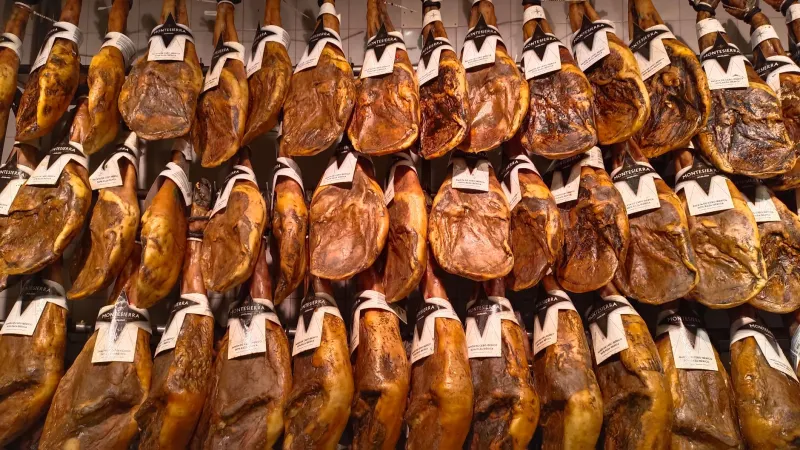
In a converted stone outbuilding on a farm in the Wye Valley, one producer has been working through a programme of reconstruction that has taken the better part of a decade. The walls are hung with legs and shoulders in various stages of cure, and the air carries that particular smell — salt and time and something faintly mineral — that curing rooms develop when they have been in continuous use.
She came to charcuterie through farming rather than cooking. When she and her partner took on the farm and began raising rare-breed pigs — a herd of Gloucester Old Spots and a small number of Oxford Sandy and Blacks — the question of what to do with the whole animal became urgent. The answer, eventually, was to learn to cure it.
"I started with the obvious things — bacon, a simple air-dried loin," she explains, slicing a paper-thin piece from a cured shoulder and holding it to the light. "Then I started reading. And the more I read, the more I realised how much had been here and was gone. I wanted to know what a proper Gloucestershire-cured pig actually tasted like. Nobody alive could tell me. So I had to figure it out."
Figuring it out involved sourcing old texts, corresponding with food historians, and — crucially — developing relationships with other producers across the country who were working through similar questions. The network that has formed around this shared project is informal but genuine: a community of practice held together by group chats, occasional gatherings, and a collective commitment to getting things right rather than simply getting things made.
Regional Identity on a Plate
One of the more compelling arguments made by producers in this movement is that charcuterie is not merely a preservation technique. It is, at its best, a form of regional identity — a way of expressing the character of a place through the animals raised there, the salt used to cure them, and the conditions in which they hang. The terroir argument that is increasingly applied to cheese and cider applies here too, perhaps even more forcefully, because the variables are so numerous and their effects so pronounced.
A dry-cured leg from a Tamworth pig raised on a Shropshire farm, hung in a cool stone larder through a wet English winter, will taste of all of those things. Not metaphorically. Actually. The breed determines the fat distribution and flavour of the meat. The feed shapes the fat itself. The curing recipe — its proportions of salt, sugar, and any additional flavourings — reflects local tradition and local taste. The environment in which it hangs, with its particular humidity and temperature fluctuations, shapes the final product in ways that cannot be fully controlled or entirely predicted.
This is, of course, the opposite of what industrial food production is designed to achieve. Industrial production aims for consistency, predictability, and scalability. What these makers are producing is inherently variable, inherently local, and inherently limited in quantity. That is not a commercial weakness. For a growing number of customers — and a growing number of chefs — it is the entire point.
Scotland, Wales, and the Wider Picture
The revival is not limited to England. In Scotland, a small number of producers are working to reconstruct curing traditions tied to specific breeds — Saddleback crosses, rare Berkshires — and to the particular character of Scottish salt and smoking traditions. The intersection of curing and smoking in Scottish practice is especially interesting, producing products that sit somewhere between the charcuterie traditions of the south and the smokehouse culture of the north.
In Wales, the focus has often been on lamb and mutton as much as pork — a reflection of the fact that sheep farming has always dominated the Welsh uplands. Cured and dried mutton, once a staple of Welsh rural households, is being produced again by a handful of makers who have found the historical recipes and are now working out how to apply them to contemporary breeds and contemporary kitchens. The results are striking: intensely flavoured, deeply savoury, and entirely unlike anything currently available in mainstream retail.
Northern Ireland, with its complex food heritage drawing on multiple traditions, is perhaps the most interesting case of all. Producers there are working with a history that includes both the Ulster curing traditions documented in eighteenth and nineteenth-century estate records and older Gaelic preservation methods that have left only fragmentary traces. Reconstructing that picture requires a kind of intellectual humility — an acknowledgement that the full story may never be recoverable — alongside a practical commitment to making something real and good from what can be found.
Why It Matters
It would be easy to frame this as a niche pursuit — a few enthusiasts in outbuildings, making small quantities of expensive product for a limited audience. That framing would be wrong, or at least incomplete. What is happening in these curing rooms is not separate from the broader questions facing British food culture. It is a response to them.
How do we produce food that reflects where it comes from? How do we support the rare breeds and small farms that mainstream supply chains cannot accommodate? How do we recover knowledge that was nearly lost without pretending that recovery is simple or complete? How do we make things that are genuinely worth eating, rather than merely convenient?
The dry-salters and charcutiers working through these questions are doing so with their hands as much as their minds. The salt goes into the meat. The meat goes into the larder. Time does the rest. It is, in the end, the oldest story in British food — and it turns out there is plenty of it still to tell.