Fit for a King: The Prehistoric River Creature Reclaiming Its Place on Britain's Table
Fit for a King: The Prehistoric River Creature Reclaiming Its Place on Britain's Table
There is something deeply unsettling about a lamprey. It has no jaw, no scales, and a circular mouth ringed with rasping teeth that looks more like something from a science fiction film than the British countryside. And yet this creature — older in evolutionary terms than the dinosaurs — was once so prized by English monarchs that entire towns paid their taxes in lamprey pies. Henry I, if the chronicles are to be believed, ate himself to death on a surfeit of them. History doesn't get much more British than that.
 Photo: Henry I, via c8.alamy.com
For most of the twentieth century, the lamprey faded almost entirely from the national consciousness. Pollution, weirs, and the general degradation of Britain's river systems pushed populations to the margins. The fishermen who once knew the old catching methods aged out without passing on their knowledge. The recipes disappeared into manuscript libraries. And the lamprey itself became something of a curiosity — a footnote in medieval history rather than a living part of Britain's food culture.
But something is changing on rivers like the Severn and the Wye. Quietly, almost imperceptibly, the lamprey is coming back.
A Fish Out of Time
To understand why the lamprey matters, you need to understand what it actually is. Brook lampreys, river lampreys, and sea lampreys are all found in British waters, and they represent a lineage that stretches back some 360 million years. They are, in the most literal sense, living fossils — creatures whose basic body plan has barely changed since before the first trees appeared on Earth.
Sea lampreys are the largest and the ones with the most culinary history. They spend part of their lives at sea, returning to freshwater rivers to spawn, much like salmon. It is during this spawning migration that they were traditionally caught — exhausted, fat, and clustered in predictable runs that made them accessible even to fishermen using the most basic of tackle.
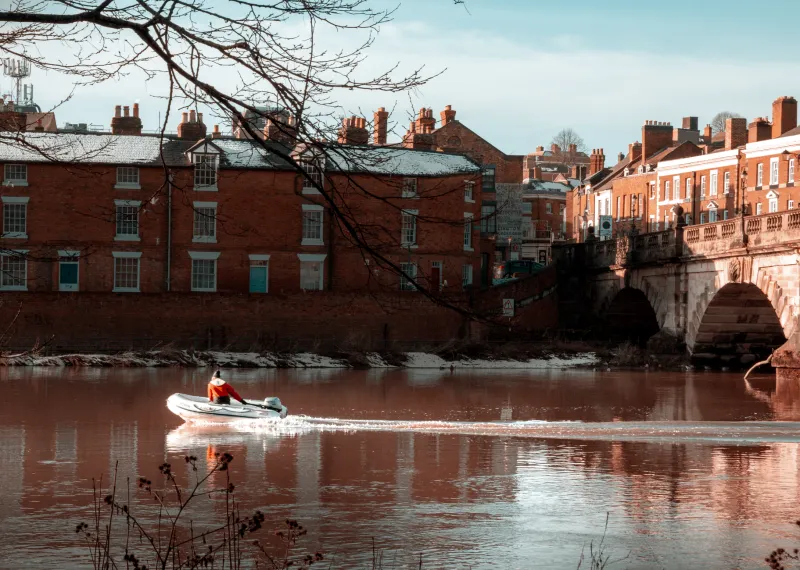
The Severn, in particular, was once famous for its lamprey harvest. Gloucester's civic identity was bound up with the creature for centuries; the city presented lamprey pies to the Crown as a form of ceremonial tribute right up until the twentieth century. When the last pie was sent to mark the Queen's Silver Jubilee in 1977, it was something of a valediction — a farewell to a tradition that had already lost its living roots.
The Men Who Remember
Finding anyone who still knows how to catch a lamprey in the traditional manner requires patience and a willingness to follow some fairly obscure leads. But they exist. Along the lower Severn, a handful of older fishermen retain knowledge of the eel putcheon baskets and stone traps that were once used to intercept lamprey runs. Most are reluctant to talk — partly out of habit, partly because the legal status of lamprey fishing is complicated by conservation protections that have been introduced as populations have struggled.
One retired fisherman, speaking from a cottage near Tewkesbury, describes the old method with the quiet authority of someone recalling a skill absorbed in childhood rather than formally taught. "You'd know the run was on by the time of year and the water temperature," he says. "They'd come up in the dark, mostly. You'd set your traps in the evening and check them before first light. Some years you'd get nothing. Other years the basket would be heaving."
The trapping of lampreys today sits in a legally grey area. All three British species enjoy protection under the Habitats Regulations, and any commercial exploitation would require careful licensing. Conservation organisations are generally supportive of the species' recovery but cautious about anything that might reverse hard-won population gains.
What the Cookbooks Forgot
While the ecologists monitor the river counts, a small community of food historians has been working on the other half of the problem: what on earth do you actually do with a lamprey once you have one?
Medieval lamprey recipes are not difficult to find if you know where to look. They appear in manuscripts from the fourteenth and fifteenth centuries, often calling for the fish to be stewed in its own blood — a technique that sounds alarming to modern ears but reflects a broader medieval comfort with the full use of an animal. Spices like ginger, cinnamon, and galingale were commonly added, along with wine and verjuice, producing something closer to a rich, dark braise than anything we would recognise as a fish dish today.
Several chefs with an interest in historical British cooking have attempted modern interpretations. The challenge, most agree, is that lamprey flesh is extraordinarily rich — fatty in a way that most river fish simply are not — and requires balancing rather than showcasing. "You're not cooking a trout," says one London-based cook who has experimented with the species using legally sourced specimens from the Continent, where commercial lamprey fishing remains permitted in parts of Portugal and France. "The fat content is closer to eel than anything else. It wants acidity. It wants something to cut through it."
Recovery and Responsibility
The ecological news, at least, is cautiously encouraging. River restoration projects along the Severn, Wye, and several of their tributaries have removed or bypassed historic weirs that previously blocked lamprey migration routes. Water quality improvements have made spawning gravels accessible for the first time in decades. Survey data from the Environment Agency and Natural Resources Wales suggest that sea lamprey numbers are recovering, albeit slowly and unevenly.
Whether that recovery will ever be sufficient to support any kind of regulated, sustainable harvest remains genuinely uncertain. Some conservationists argue that the idea should be set aside entirely — that lamprey populations are too fragile and too important as an indicator species to risk. Others take a more nuanced view, suggesting that a carefully managed, small-scale harvest, modelled on the kind of traditional ecological knowledge that once regulated the fishery, could be compatible with conservation goals.
What is clear is that the conversation is worth having. Britain has a long and honourable tradition of eating from its rivers — a tradition that is part of what this country is, culturally and ecologically. The lamprey sits at the very heart of that tradition, older than the monarchy it once fed, stranger than almost anything else that swims in British water.
Gloucester's civic coat of arms still bears three lampreys. The creature is woven into the fabric of the place in a way that goes beyond food. Bringing it back to the table — thoughtfully, responsibly, with full awareness of the ecological stakes — would be an act of genuine cultural recovery. Not nostalgia. Something more serious than that.
Somewhere on the Severn tonight, the lampreys are running. Whether anyone will ever again be waiting for them with a basket and a recipe is a question that Britain's rivers, and Britain's conscience, have not yet answered.