Buried Cold: The Georgian Ice Houses Breathing Life Back Into Britain's Estate Larders

Photo by Photo by Tanya Barrow on Unsplash on Unsplash
Buried Cold: The Georgian Ice Houses Breathing Life Back Into Britain's Estate Larders
The door is low, the passage steep, and the air that hits you when you descend is startlingly cold for a building that hasn't seen a block of ice since the 1930s. The brick-lined chamber at the bottom — a perfect egg-shaped dome, about four metres across — sits roughly five metres below the surface of a Northumberland parkland lawn, and it maintains a temperature of between three and five degrees Celsius throughout the summer without any mechanical assistance whatsoever. It does this, as it has done for roughly two hundred and thirty years, simply by being what it is: a very well-insulated hole in the ground, engineered by people who understood cold in ways that the age of the electric refrigerator has made us rather lazy about.
'The Victorians weren't improvising,' says the estate manager who oversees this particular structure, now pressed back into service as a game larder. 'They had centuries of empirical knowledge about how to keep things cold. We've just spent a hundred years forgetting it.'
The Architecture of Cold
Britain's ice houses are among the most underappreciated examples of functional architecture in the country. Built from the seventeenth century onwards on estates large enough to afford them, they were designed with a sophistication that rewards close examination. The classic form — a domed underground chamber with a long, north-facing entrance passage — isn't arbitrary. The dome distributes structural load while minimising the surface area from which heat can enter. The passage acts as a thermal lock, trapping cold air at the base of the descent. The drainage channel at the floor's lowest point removes meltwater before it can raise the internal humidity and accelerate the deterioration of stored food.
Ice was harvested from estate ponds and lakes during hard frosts, packed into the chamber in layers with straw or bracken as insulation, and could be expected to last well into summer — sometimes beyond. The estate kitchen relied on it for everything from chilling butter and cream to preserving the fish and game that formed the backbone of the Victorian country house larder.
Most of these structures fell out of use when mechanical refrigeration became affordable in the early to mid-twentieth century. Doors were sealed, passages filled in, and the domes gradually forgotten beneath encroaching turf and shrubbery. English Heritage estimates that several hundred survive in some form across England alone, with further examples in Scotland and Wales. The majority remain unused.
A Northumberland Venison Larder
On the Northumberland estate where we began, the ice house was rediscovered in 2019 when a groundsman noticed an unusual depression in the lawn and, curious, began to investigate. Restoration took the better part of a year — repointing the brickwork, clearing the drainage channel, and rebuilding the insulated inner door — but the result is a larder that the estate's deer manager now considers essential to the quality of his venison.
'Hanging game properly is everything,' he explains, standing in the cool dimness of the chamber with a haunch of roe deer suspended above him. 'You want a consistent low temperature, good air circulation, and no mechanical noise or vibration. This place gives you all three. A commercial cold room is too cold, too wet, and too noisy. This is exactly right.'
The venison hung here — red and roe deer from the estate's own woodland — is supplied to two restaurants in Newcastle and a small butchery in Hexham. The provenance story, the estate manager admits, doesn't hurt. But the quality argument is the one that keeps the chefs coming back.
Shropshire Cheese and the Patience of Stone
In Shropshire, a different kind of cold work is underway. A dairy farmer near Much Wenlock, producing a semi-hard raw milk cheese from her herd of Brown Swiss cattle, began using a restored ice house on her land three years ago as an ageing chamber. The results, she says, have been transformative.
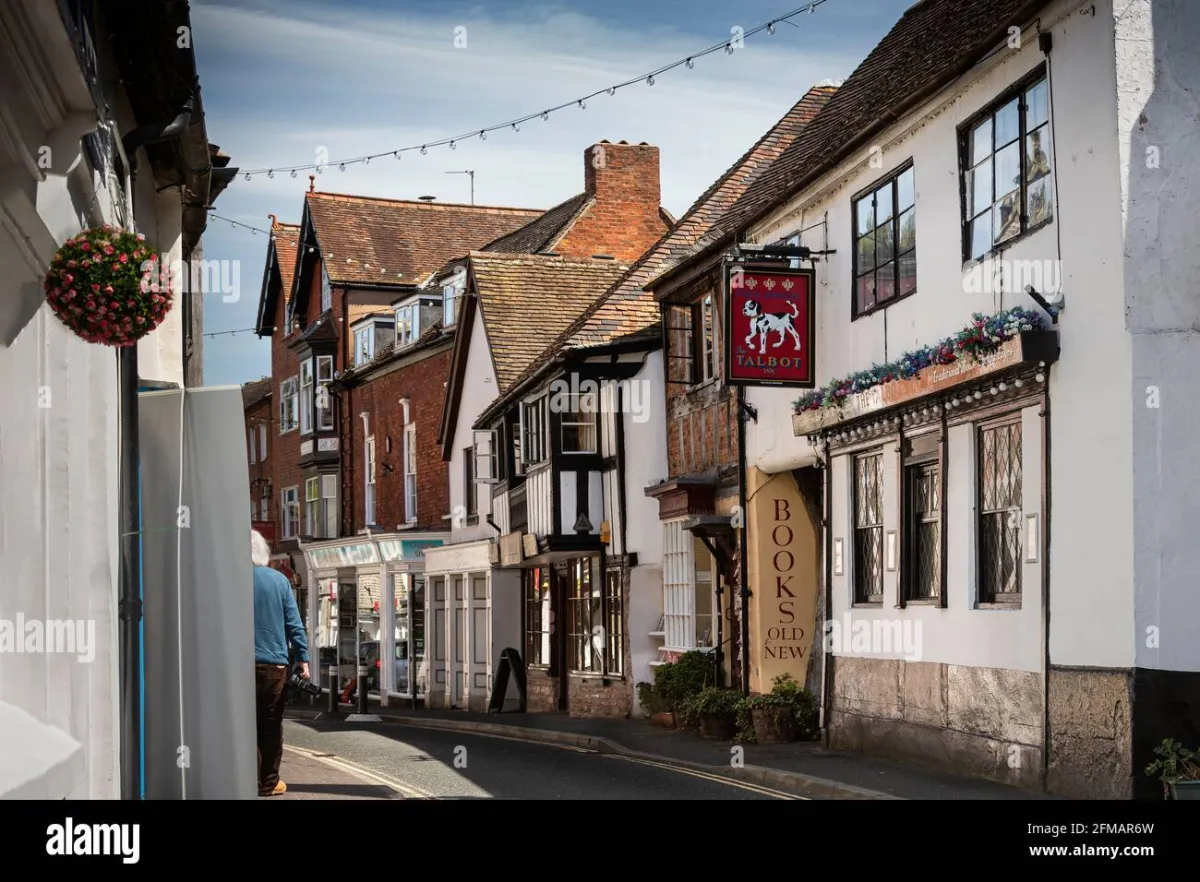 Photo: Much Wenlock, via c8.alamy.com
'I'd been using a purpose-built ageing room with temperature and humidity controls, and the cheese was good. But there was something slightly flat about it.' The ice house, with its naturally stable temperature and the faint mineral dampness of its old brick walls, introduced what she describes as a 'geological quality' to the rind — a complexity that she suspects comes from the native moulds and bacteria colonising the ancient masonry.
Her cheese is now stocked by two London cheesemongers who describe it as unlike anything else currently being produced in the Midlands. Both cite the rind character — its earthy depth, its slight roughness — as the distinguishing quality.
The Rediscovery of Intelligent Cold
What connects these projects, and the handful of others scattered across Britain's estate landscape, is a growing recognition that the pre-refrigeration cold chain wasn't simply a primitive precursor to modern food technology. It was a sophisticated, site-specific system developed over generations by people who understood that different foods have different cold requirements — and that the goal was never merely preservation, but the careful management of transformation over time.
A hung pheasant and a ripening cheese and a river-caught trout waiting for the table are not the same problem. They require different temperatures, different airflows, different levels of humidity. The Georgian ice house, with its stable, naturally calibrated environment, turned out to be surprisingly good at accommodating all of them — better, in some cases, than the blunt uniformity of a modern refrigerator set to four degrees and left to hum.
There's something rather satisfying about that. The people who built these structures couldn't have imagined the world we've built since, but they understood cold, and food, and time in ways that are proving quietly relevant again. Digging them out, dusting them off, and asking them to do their old work once more feels less like heritage tourism and more like a genuinely sensible idea.