Paradise Lost in the West Country
Drive through Herefordshire today and you'll glimpse them — ghostly remnants of what was once England's most magical agricultural landscape. Ancient apple trees stand like weathered sentinels in fields now given over to barley and maize, their gnarled limbs heavy with lichen, their hollow trunks home to owls and bats. These are the survivors of Britain's traditional cider orchards, and they're dying.
Not so long ago, these orchards stretched across vast swathes of the West Country, Herefordshire, Kent, and beyond. They weren't just farms — they were ecosystems of extraordinary richness, supporting more wildlife per acre than any other agricultural habitat in Britain. The trees themselves were marvels of adaptation, varieties with names like Foxwhelp, Kingston Black, and Stoke Red, each selected over centuries for specific qualities that industrial production would never understand.
The Great Grubbing-Up
The destruction began in earnest during the 1960s and 70s, when government grants actively encouraged farmers to grub up old orchards and replace them with arable crops or modern high-density plantations. The reasoning seemed sound at the time: traditional orchards were seen as inefficient, their ancient trees producing lower yields than modern alternatives, their mixed varieties unsuited to industrial cider production.
The statistics are sobering. Since 1950, Britain has lost over 60% of its traditional orchards. In some counties, the figure approaches 90%. Worcestershire alone lost 85% of its orchard acreage between 1950 and 1997. Each grubbed-up acre represented not just lost agricultural heritage, but the destruction of irreplaceable wildlife habitat and the extinction of apple varieties that had taken centuries to develop.
More Than Just Apples
What we lost wasn't merely fruit production — it was Britain's richest farmland ecosystem. Traditional orchards, with their widely spaced trees, rough grassland, and minimal chemical inputs, supported an astonishing array of wildlife. Over 1,800 species have been recorded in traditional orchards, from rare lichens that festoon the bark to noble chafer beetles that breed in the rotting heartwood.
The understory grassland, grazed by sheep or cattle, developed into species-rich meadows that modern agriculture has largely eliminated elsewhere. Cowslips and primroses carpeted the ground in spring, followed by orchids and meadow saffron. This botanical diversity supported equally rich insect communities, which in turn fed resident and migrant birds.
"A traditional orchard in full cry is like a three-dimensional nature reserve," explains Dr. Liz Copas, pomologist and orchard conservation specialist. "You have the canopy ecosystem in the trees, the grassland ecosystem below, and all the interactions between them. It's one of the most biodiverse agricultural systems ever developed."
The Flavour Revolution
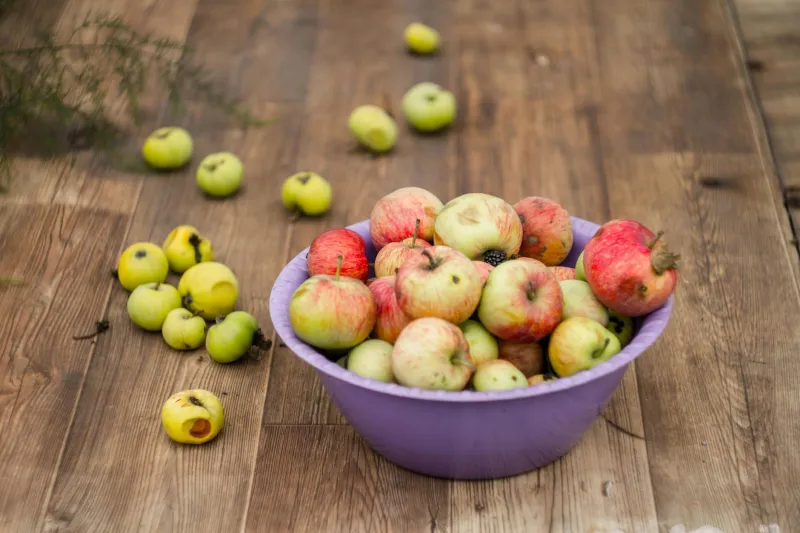
Yet the trees themselves remain the stars of this ecological drama. Traditional cider varieties weren't bred for appearance or shelf life, but for flavour complexity that would astound anyone familiar only with supermarket offerings. These apples fell into distinct categories: bittersweets provided tannins and body, bittersharps added acidity and bite, sweets contributed fermentable sugars, and sharps brought crucial acidity to balance the blend.
Each variety had its role, its season, its particular contribution to the final cider. Kingston Black was prized as a "single variety" apple — one that could make exceptional cider without blending. Dabinett provided reliable tannins and good keeping qualities. Yarlington Mill added complexity with its high sugar content and distinctive flavour profile.
These weren't mass-market apples. Many were so astringent or acidic that eating them fresh would pucker your mouth for hours. But fermented into cider, they created beverages of extraordinary depth and character — drinks that spoke of their particular soil, climate, and season in ways that industrial ciders simply cannot match.
The Passionate Preservers
Across the country, a dedicated community refuses to let this heritage disappear without a fight. From commercial producers like Oliver's Cider in Herefordshire to community orchards in urban areas, passionate individuals are planting, grafting, and nurturing these ancient varieties back from the brink.
Tom Oliver, whose family has been making cider in Herefordshire for over a century, maintains one of the most diverse collections of traditional varieties in Britain. "Every apple tells a story," he says, walking through his orchards where 40 different varieties grow. "When we lose a variety, we lose part of our cultural DNA. These apples carry the wisdom of generations of growers."
 Photo: Tom Oliver, via i0.wp.com
The work isn't easy. Many traditional varieties exist only as a few elderly trees scattered across the countryside. Locating them requires detective work — following up on local knowledge, checking old maps, sometimes finding single trees surviving in forgotten corners of farmyards. Once found, the varieties must be grafted onto new rootstock, a skilled craft that requires both horticultural knowledge and artistic sensibility.
Wildlife Refuges in a Changing Landscape
The conservation movement extends beyond fruit production to habitat restoration. The Traditional Orchard Project, supported by various wildlife trusts, helps landowners restore neglected orchards and create new ones using traditional methods. The focus isn't just on apple varieties, but on recreating the entire ecosystem — the right tree spacing, the appropriate grass mixture, the traditional management practices that maintained such rich biodiversity.
These restored orchards are already showing results. Bird surveys reveal species returning that had been absent for decades. Botanical surveys find rare plants recolonising from seed banks that lay dormant in the soil for years. The orchards become stepping stones in the landscape, connecting fragmented habitats and providing refuge for wildlife squeezed out of intensively farmed areas.
The Economics of Heritage
Yet conservation efforts face stark economic realities. Traditional orchards are labour-intensive to manage and produce lower yields than modern alternatives. The apples they grow often have no commercial market beyond specialist cider makers and heritage enthusiasts. Without economic viability, even the most passionate conservation efforts struggle to maintain momentum.
Some producers are finding innovative solutions. Agritourism brings visitors to experience blossom time and harvest festivals. Rare variety ciders command premium prices from discerning consumers. Educational programs connect schools with local orchards, teaching children about food production and environmental stewardship.
Government policy is slowly shifting too. Environmental stewardship schemes now recognise traditional orchards as priority habitats, offering payments for restoration and maintenance. Planning policies increasingly protect existing orchards from development. The tide may be turning, but slowly.
Racing Against Time
Meanwhile, the clock ticks for the remaining heritage varieties. Each winter storm that brings down an ancient tree, each development that consumes an old orchard, potentially represents the extinction of genetic material that can never be recovered. Pomologists estimate that Britain has already lost over 3,000 apple varieties since systematic recording began.
The survivors cling on in unexpected places — cottage gardens, abandoned farmyards, roadside hedgerows where old trees were once part of field boundaries. Citizen science projects like the Orchard Network encourage volunteers to report discoveries of old varieties, building a living map of Britain's pomological heritage.
The Future in Every Pip
As climate change brings new challenges to agriculture, these old varieties may hold keys to resilience that modern breeding programs have overlooked. Traditional apples were selected for local adaptation, developing resistance to regional pests and diseases, tolerance for specific soil conditions, ability to thrive in particular microclimates.
The revival of craft cider making has created new markets for heritage varieties, while growing environmental awareness has increased appreciation for biodiverse farming systems. Young growers are rediscovering the satisfaction of working with nature rather than against it, creating productive landscapes that support both human needs and wildlife abundance.
Yet time remains short. The window for preserving Britain's orchard heritage is rapidly closing. Each saved variety, each restored orchard, each new generation of cider makers learning traditional skills represents a small victory against the tide of agricultural uniformity.
In the end, the question isn't just about apples or cider — it's about the kind of countryside we want to inhabit, the kind of food system we want to support, the kind of heritage we choose to preserve for future generations. The ancient orchards offer us a glimpse of what sustainable agriculture might look like: productive, beautiful, and alive with the buzz and song of countless creatures sharing in the abundance.
The fight to save them is really a fight to save ourselves — to preserve the diversity, the flavour, and the wild richness that once defined the British landscape.