Claws Against the Bank: The Case for Eating Britain's Signal Crayfish
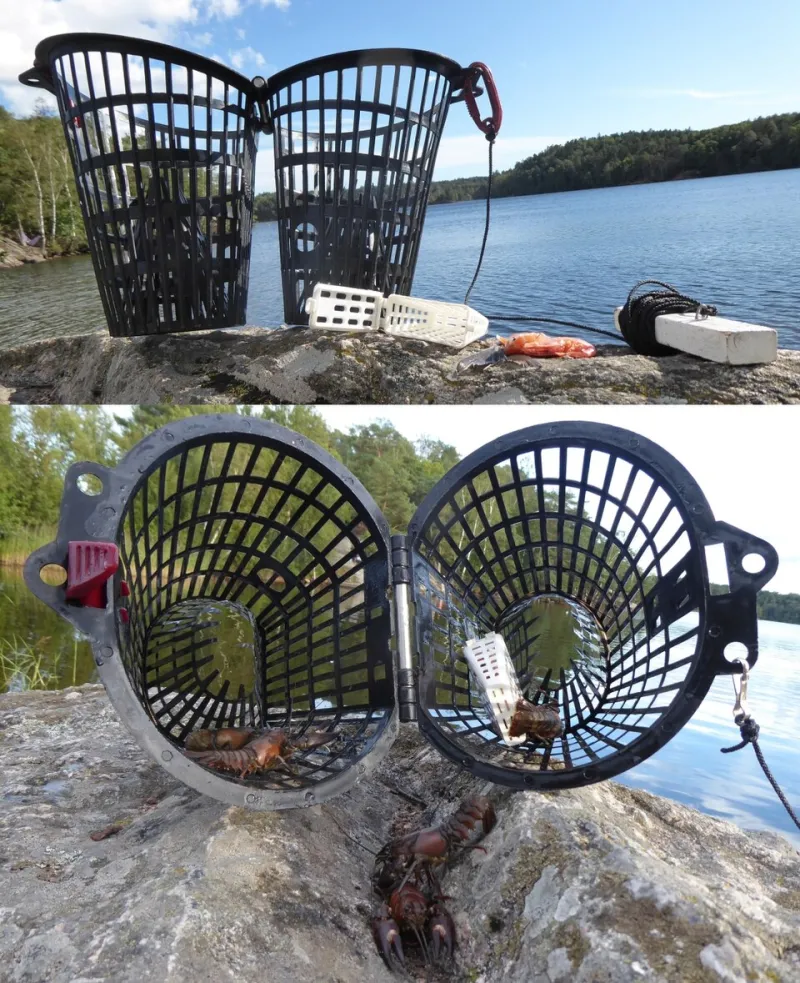
Photo: R. Henrik Nilsson, CC BY 4.0, via Wikimedia Commons
There is a stretch of chalk stream where the bank looks like it has been shelled. Holes the width of a fist, some far bigger, punched into the earth at water level, silt fanning out into what should be clean gravel. That is signal crayfish work, and once you have seen it you stop thinking of them as a slightly exotic addition to a river and start thinking of them as a demolition crew that happens to be edible.
Signal crayfish arrived in Britain in the 1970s, brought over from North America for farming. They escaped, as farmed animals do, and they brought with them a fungus to which they are largely immune and to which our native white-clawed crayfish is not. Crayfish plague has since done what plague usually does. Native populations have collapsed across most of England, and the signal has filled the gap and then some.
What they do to a river
Signals are bigger, more aggressive and far more numerous than the native species ever was. They burrow into banks, sometimes deep enough to undermine them, and the soil they shift silts up gravel beds that fish need for spawning. They eat invertebrates, fish eggs, small fish, each other. In a chalk stream that has spent centuries being managed for trout and grayling, they are about as welcome as a fire in a hay barn.
So far, so straightforward. The awkwardness starts when you try to do something about it.
How the trapping actually works
The tool of choice is a trap baited with fish — a plastic trap with funnels at either end, dropped on the riverbed overnight. Trapping in England requires authorisation from the Environment Agency, and the rules are strict for good reason: you may not put a signal crayfish back in the water, you may not move them live, and you must dispatch them properly. Scotland goes further and treats the whole thing as an eradication problem rather than a harvest.
The labour is the killer. Traps must be lifted, emptied, rebaited and reset, day after day, in all weathers, on rivers that are often a long walk from the nearest road. A good trapper might take a few kilos on a good night and very little on a bad one. Warm weather helps; cold water slows everything down, and berried females should be left alone. It is a job that pays in kilos, not in hours, and the kilos are not reliable.
The kitchen problem
Then there is the question of what to do with them. Crayfish are, in culinary terms, somewhere between a langoustine and a langoustine's poorer cousin. The tail meat is sweet and delicate; the shells make an outstanding bisque or stock; the claws are worth picking if you have the patience of a saint. What you do not get is a generous yield. A pile of crayfish looks like a feast and eats like a starter.
Chefs who have taken them on tend to go one of two ways. Either the full Scandinavian boil — dill, salt, beer, newspaper on a trestle table — or the French route, into a bisque or a sauce where a lot of shells give a lot of flavour cheaply. Both work. Neither is going to fill a dining room on its own.
The awkward business of eating an invader
Here is the opinion. "Eat the invader" is a fine slogan and a poor strategy. The people doing the real conservation work are the trappers, and they deserve a market. But the moment a serious commercial demand exists for signal crayfish, someone will find a way to supply it, and that someone will not be standing in a chalk stream at five in the morning. Commercially farmed signals are exactly how this country got into the mess in the first place.
So the terms of engagement need to be brutally clear. Wild-caught, from authorised trapping, dispatched on site, never moved live, never farmed, never stocked. Buy from trappers who can tell you which river. Support the river trusts and fisheries that run trapping programmes. And accept that this is a small, seasonal, awkward supply of a genuinely good ingredient rather than a solution to an ecological crisis.
That said — if you see signal crayfish on a menu at a pub near a chalk stream, order it. Somebody got up at dawn to catch it, the river is marginally better off for it, and you get a bowl of sweet pink tails in garlic butter. There are worse transactions to make with the British countryside.