Stock and Substance: Britain's Long Simmer Back to the Bone
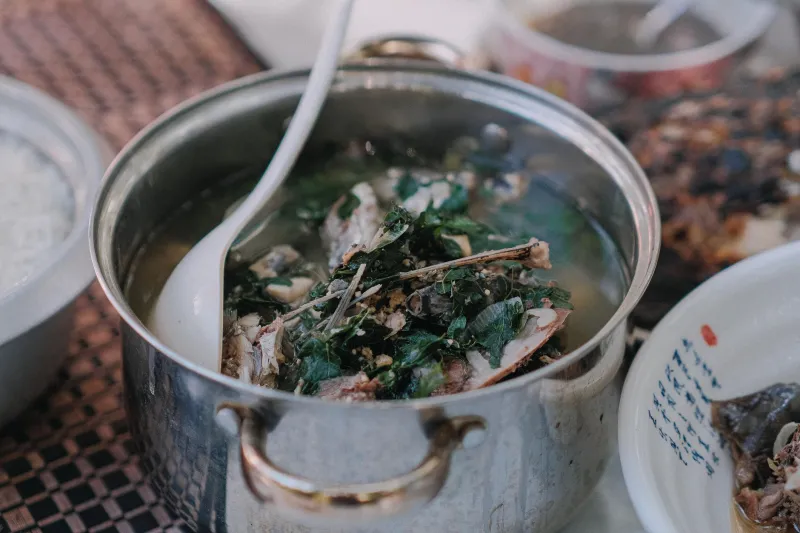
Ask anyone over seventy-five what their mother did with the Sunday roast chicken carcass, and the answer will be immediate and consistent. Into the pot it went, with an onion, a few peppercorns, whatever vegetables were looking tired at the bottom of the rack, and enough cold water to cover. By Monday morning, the kitchen smelled of something deep and golden, and there was stock enough for soup, for gravy, for cooking rice or barley. Nothing was wasted. Nothing was bought that didn't need to be.
Somewhere between the postwar convenience revolution and the rise of the stock cube, that habit was largely lost. Now, in a movement that's as much about economics and sustainability as it is about wellness, it's being found again.
What Got Lost and Why
The decline of bone broth — or proper stock, to use the kitchen term that carries less baggage — tracks neatly with the industrialisation of British food. When butchers began selling pre-portioned cuts rather than whole carcasses, and when supermarkets made boneless, skinless, ready-to-cook protein the default, the bones simply disappeared from most shopping baskets. They were still there, of course, being rendered down in industrial facilities, but they were no longer part of the domestic kitchen conversation.
The stock cube arrived as a solution to a problem that many households hadn't yet noticed they had. Convenient, cheap, and consistent, it replaced something that was also free, infinitely variable, and nutritionally far richer. The trade-off, in retrospect, seems a poor one.
Butchers who survived the supermarket era largely did so by adapting — and many of them will tell you that bones and frames are among the products they're now asked for most frequently. "Five years ago, I was practically giving chicken carcasses away," says James Partridge, who runs a traditional butcher's shop in Hereford. "Now I can't keep up with demand. People are asking for beef knuckles, ox tails, chicken feet — things I used to struggle to move. It's changed completely."
The Countryside Kitchen Connection
The resurgence isn't happening in a vacuum. It's deeply connected to broader shifts in how people think about food — particularly in rural areas, where the relationship between animal husbandry and kitchen practice has always been closer.
On farms that rear their own beef, lamb, or pigs, nose-to-tail eating has never really gone away. When you've watched an animal grow, it feels natural — necessary, even — to use every part of it. Farmers and smallholders who process their own meat are often the most enthusiastic stock-makers, partly out of ingrained thrift and partly because they understand that the flavour in a well-made bone broth is the flavour of the animal, the land, and the time invested in raising it properly.
Hannah Griffiths, who keeps a small herd of native-breed cattle on the Welsh borders, makes stock from every set of bones that comes off the carcass. "The marrow bones go in the oven first, to roast," she explains, standing at the Aga that dominates her farmhouse kitchen. "Then into the pot with water, a splash of apple cider vinegar to draw out the minerals, and whatever I have — carrots, celery, bay leaves. It goes on in the evening and comes off in the morning. The house smells extraordinary."
Hannah's beef bone broth is a deep, mahogany-coloured liquid that sets firm in the fridge — a sign of the collagen content that makes it so nutritionally dense. She uses it as the base for stews and braises, reduces it for sauces, and drinks a mug of it plain, seasoned with a little salt, on cold mornings.
Game Bones and Forgotten Flavours
Beyond the farmyard, the game larder offers some of the most interesting material for the stock pot. Venison bones — particularly from the neck and shank — produce a broth of extraordinary depth, dark and slightly sweet, with a wildness that no commercially produced stock can replicate. Pheasant carcasses, often available cheaply or even free from shoots during the season, make a delicate, slightly gamey stock that's brilliant under a risotto or as the base of a cream sauce.
Grouse bones, given their richness and the intensity of the birds' moorland diet, produce something more assertive still — a stock that tastes unmistakably of heather and high ground. It's not a subtle thing, but used with a light hand in a game pie or a simple braise, it's magnificent.
The key with game stocks, as with all bone broths, is time and temperature. A rolling boil produces a cloudy, slightly bitter result. A gentle, barely-there simmer — with the surface skimmed regularly in the early stages — produces something clear and clean, with all the flavour and none of the murkiness.
A Recipe Worth Keeping
For those starting out, chicken is the most forgiving introduction. Roast your carcass in a hot oven for twenty minutes until it's golden and beginning to colour at the edges. Transfer to your largest pot with a halved onion (skin on, for colour), two carrots, two celery sticks, a bay leaf, a few peppercorns, and a tablespoon of cider vinegar. Cover with cold water and bring slowly to the barest simmer. Skim the grey foam that rises in the first twenty minutes, then leave it alone for at least four hours — six is better, eight better still.
Strain through a fine sieve, allow to cool, and refrigerate overnight. The fat will solidify on the surface and can be lifted off and kept for cooking. What remains is proper stock: golden, wobbling slightly when cold, and full of the kind of flavour that no cube or carton has ever come close to replicating.
Thrift Made Fashionable
There's something slightly ironic about the fact that what working-class British kitchens did out of pure necessity has now acquired a wellness halo and a premium price tag in health food shops. Bottled bone broth sells for several pounds for a fraction of what a home batch costs to make, and the marketing around collagen, gut health, and amino acids is considerable.
But strip away the wellness language, and what you're left with is something very simple: a practice that makes the most of an animal, produces something genuinely nourishing, and connects the cook to a long tradition of British kitchen wisdom. That, more than any health claim, is reason enough to get the stockpot out.