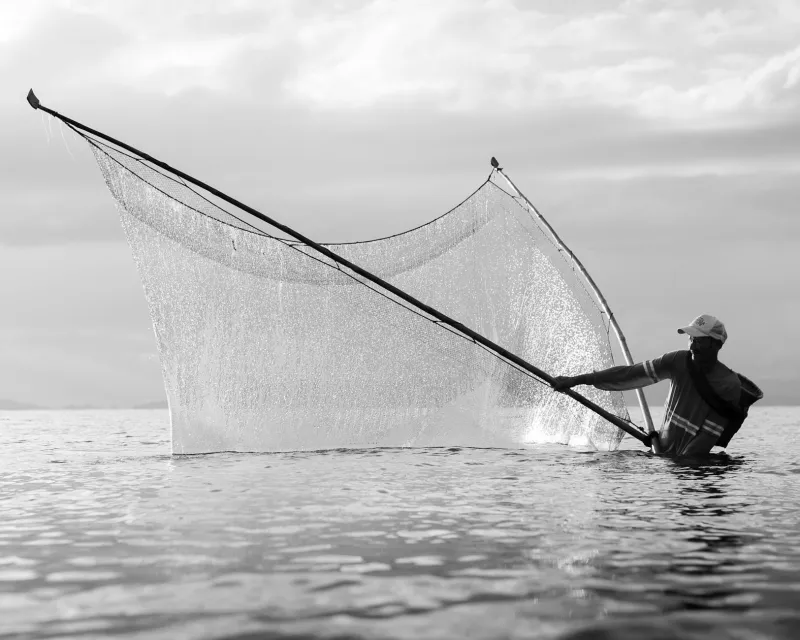
The wind carries salt and stories across Scapa Flow as Magnus Sinclair wades chest-deep into waters that have claimed Vikings, warships, and countless fishing boats. In his weathered hands, he grips a rectangular net frame - a haaf net - that his great-grandfather might have recognised, though the knowledge of how to use it nearly died with the last generation.
"Folk think we're mad," Magnus grins, seawater streaming from his waxed jacket as another wave crashes against his legs. "Standing in open water, waiting for fish to swim into your net. But this is how our people fed themselves for a thousand years."
Ancient Waters, Ancient Ways
Haaf netting - from the Old Norse 'haf' meaning sea - differs markedly from the estuary and river fishing traditions found elsewhere in Britain. Where most net fishing relies on tidal channels and enclosed waters, haaf netting demands that fishermen venture into open coastal waters, reading currents and weather with an intimacy born of generations.
The technique arrived with Norse settlers in the 9th century, who found Orkney's unique tidal geography perfect for this style of fishing. Unlike the salmon nets of Scottish rivers or the ancient weirs of Welsh estuaries, haaf nets target the mixed shoals that follow Orkney's complex tidal flows - cod, saithe, haddock, and the occasional sea trout that venture close to shore.
"The Pentland Firth creates currents you won't find anywhere else in British waters," explains Dr Sarah Henderson, a marine historian at the University of the Highlands and Islands. "These tidal races concentrate fish in predictable patterns, but only if you understand the water like your ancestors did."
Reading the Runes of Wind and Tide
For Magnus and the small band of haaf netters working to revive the tradition, that understanding comes through trial, error, and the fragmentary memories of elderly islanders. The technique requires fishermen to stand in water often shoulder-deep, holding their nets perpendicular to the current while waves crash around them.
"You need to feel the tide through your feet," says Morag Flett, one of only three women practicing haaf netting in modern Orkney. "When the current shifts, when the pressure changes - that's when the fish move. Your net becomes an extension of your body."
The physical demands are extraordinary. Sessions can last four to six hours, with netters anchored against currents that would sweep away the unprepared. The rectangular nets, traditionally made from horsehair but now crafted from modern materials, must be held perfectly steady while allowing the sea to flow through them.
Flavours from the Firth
The fish caught through haaf netting carry flavours distinct from their trawled counterparts. The stress-free capture - fish swim willingly into the static nets - preserves the flesh's texture, while the specific feeding grounds around Orkney impart unique characteristics.
"Saithe caught in the Pentland Firth has a sweetness you don't get elsewhere," explains local chef James Groundwater, who sources directly from the haaf netters. "These fish feed on the rich plankton blooms that the tidal mixing creates. The meat is firmer, cleaner-tasting than anything you'll buy in a supermarket."
The small scale of the operation - perhaps two dozen fish per session on a good day - means haaf-netted catches command premium prices in Orkney's restaurants and fishmongers. But for the practitioners, the economic benefits pale beside the cultural significance.
Island Identity in Deep Water
The revival of haaf netting speaks to broader questions of food sovereignty and cultural identity that resonate across Britain's island communities. In an age of industrial fishing and global supply chains, these ancient techniques offer both practical benefits and psychological anchoring.
"When I'm out there with my net, I'm connected to every generation of my family that worked these waters," reflects Magnus, preparing his gear for another session as the tide turns. "My children might choose different lives, but they'll know where they come from."
The knowledge transfer proves challenging. Unlike agricultural traditions that can be learned gradually over seasons, haaf netting demands immediate competence in dangerous conditions. The group has established informal apprenticeships, pairing experienced netters with newcomers, though the physical demands limit participation.
Preserving the Pull
Efforts to document and preserve haaf netting extend beyond the water's edge. The Orkney Museum has collaborated with practitioners to record techniques, while local schools incorporate the tradition into lessons about island heritage. The challenge lies in maintaining authenticity while adapting to modern safety requirements and fishing regulations.
"We're not museum pieces," insists Morag, checking the repair on her net frame. "This is a living tradition that feeds families and connects us to our landscape. But it has to evolve to survive."
The haaf netters have established a loose cooperative, sharing knowledge, equipment, and sometimes catches. They've also begun offering guided experiences for visitors, though always emphasising the serious nature of the work rather than treating it as entertainment.
Tides of Change
As climate change alters sea temperatures and fish migration patterns, the haaf netters find themselves adapting techniques their ancestors might not recognise. Warmer waters bring different species closer to shore, while changing weather patterns affect the timing of optimal netting conditions.
"The sea's always been changeable," notes Magnus, watching clouds gather over Hoy. "But the changes come faster now. We're learning alongside the fish."
The future of Orkney's haaf netting tradition remains uncertain, dependent on a small group of dedicated individuals and the broader community's commitment to preserving their maritime heritage. Yet in these northern waters, where Viking longships once rode the same currents, the ancient dialogue between human skill and natural rhythm continues.
Each catch represents more than sustenance - it's proof that some connections to place and tradition can survive the centuries, as enduring as the tides themselves.