Millstone and Market: The Villages Grinding Their Own Grain Again
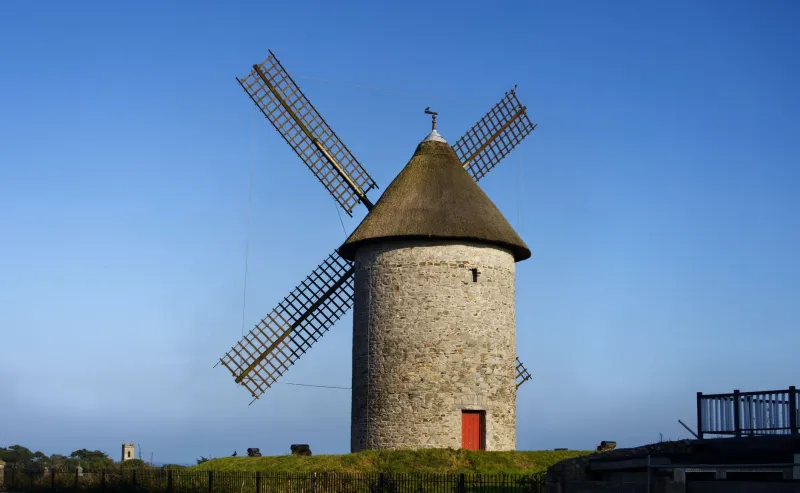
The smell hits you before the sound does. Warm, dusty, faintly sweet — the smell of grain being persuaded, slowly, into something useful. Step inside a working stone mill and you are standing in a room that smells more or less exactly as it would have done five hundred years ago. The technology has changed in detail but not in essence: two dressed stones, one turning against the other, reducing wheat to flour at a pace that a modern roller mill would find laughable. It takes longer. The flour is better. These two facts are, for the people investing in this revival, entirely the point.
Britain was once covered in mills. Every river, every stream with sufficient fall, every coastal headland with a reliable wind had one. They were the infrastructure of rural life, as fundamental as the road or the well. The miller was a figure of local consequence — sometimes trusted, sometimes resented, always essential. The industrialisation of milling in the nineteenth century changed all of that with remarkable speed. By the time the First World War ended, the village mill was already an anachronism in most of England. By the 1970s, much of what remained was either a tearoom or a ruin.
What is happening now is not a direct reversal of that history. It is something more interesting.
Why Farmers Are Milling Again
The economics of arable farming have been uncomfortable for decades. Input costs rise, commodity prices fluctuate, and the middleman — the merchant, the processor, the supermarket buyer — tends to capture the value that the farmer created. Adding a mill changes the equation. A tonne of wheat sold at commodity prices is worth a fraction of what that same tonne becomes as stoneground heritage flour sold directly to bakers and consumers.
That logic is driving a wave of on-farm milling investment across England and, increasingly, into Wales and Scotland. The mills themselves range from compact tabletop stones capable of handling a few hundred kilos a week to fully restored Victorian watermill machinery producing several tonnes. What they share is an attachment to slow milling and to older varieties of wheat.
Population wheat — the kind grown across most of Britain's arable acreage — has been bred primarily for yield and for the high-protein, easy-handling characteristics that industrial bakers require. It produces consistent, predictable flour. It does not, by most accounts, produce particularly interesting bread. Heritage varieties — Maris Widgeon, Red Lammas, Emmer, Einkorn, Hen Gymro in Wales — were bred for flavour and resilience rather than bulk output. They are lower-yielding, more variable, and considerably more demanding to work with. They also make bread with a depth and character that stops people in their tracks.
The Grain Triangle
The most compelling projects are not single operations but networks. A farmer growing heritage wheat. A miller — sometimes the same person, sometimes a neighbour — processing it on stone. A baker, usually local, building a menu around what the mill produces that week. This triangle of production, processing, and craft is genuinely novel in the modern British countryside, even though it is simply a return to how things once worked.
In Shropshire, one such arrangement has been running for four years. The farmer, who converted part of his holding to heritage varieties after struggling with the economics of conventional arable, supplies a restored watermill a few miles down the valley. The miller — a former engineer who retrained specifically for this — produces a range of flours that vary slightly from season to season depending on the harvest. A bakery in the nearest market town uses those flours almost exclusively and has built a loyal following on the basis of bread that changes, imperceptibly but genuinely, with the year.
'People find it strange at first,' the baker admits. 'They're used to a loaf that's identical every time. But once they understand that the variation is the point — that it's connected to what grew in a specific field in a specific summer — they tend to become very attached to it.'
The Infrastructure Gap
For all the enthusiasm, the practical challenges are not trivial. Millstones need regular dressing — a skilled, time-consuming process. Heritage varieties require different handling at every stage, from drilling to harvest to storage. And the supply chains that connect farmer, miller, and baker are fragile in ways that commodity chains are not, because they depend on personal relationships and shared values rather than contracts and spot prices.
Funding has been a persistent obstacle. Some projects have drawn on Countryside Stewardship payments, others on rural enterprise grants, a few on crowdfunding from communities who wanted to own a stake in their local food infrastructure. The Heritage Lottery Fund has supported several mill restoration projects on cultural grounds. But there is no single, obvious route to financing a small-scale milling operation, and many promising ventures have stalled at the capital stage.
Training is another gap. The knowledge of how to dress a millstone, how to adjust the gap for different grains, how to manage moisture through the milling process — this is not written down anywhere particularly useful. It lives in the heads of a small number of experienced millers, most of whom are generous with their time but cannot be everywhere at once. Organisations like the Traditional Cornmillers Guild are doing important work here, but the succession challenge is real.
What the Loaf Tells You
Eat a loaf made from stoneground heritage flour and you notice things you don't notice in ordinary bread. The crust behaves differently — more robust, with a quality that bakers call 'bite'. The crumb has a creamier colour and a more complex, slightly nutty flavour. It keeps better, staling more slowly than industrially milled bread. And it tends, for reasons that food scientists are still examining, to sit more comfortably with people who find commercial bread difficult to digest.
None of that is magic. It is the natural result of flour that retains more of the bran, germ, and oils that roller milling strips away, combined with wheat varieties that were selected over centuries for flavour rather than factory performance.
The village bakery and the local mill were once the quiet centre of British rural life. They are coming back — not in every village, not quickly, and not without difficulty. But they are coming back. And the bread they are producing is, by any honest measure, worth the wait.