Bletted and Beautiful: The Quiet Revival of Britain's Most Misunderstood Orchard Fruit
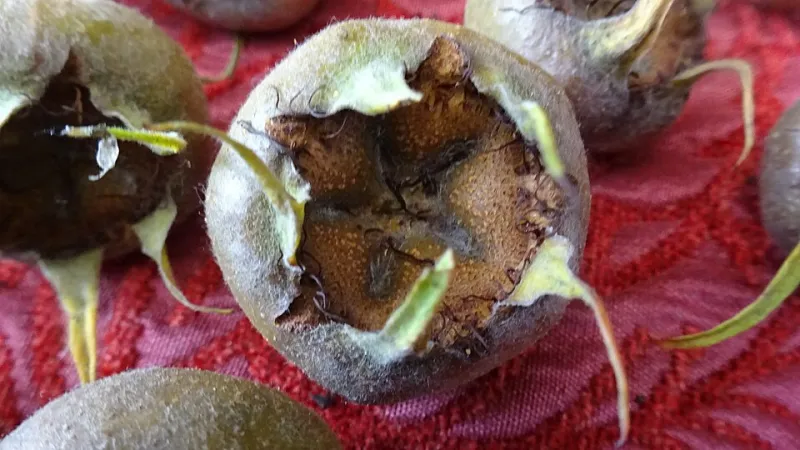
Photo: Rosser1954, CC BY-SA 4.0, via Wikimedia Commons
There is a fruit growing in Britain that you almost certainly haven't eaten. You may not have seen one. You might not even be able to picture it. The medlar — knobbly, russet-brown, roughly the size of a small apple and blessed with what can only be described as an unfortunate backside — is one of those peculiar corners of British food culture that got thoroughly left behind when convenience took over. But it's coming back, slowly and stubbornly, carried along by a handful of growers who refuse to let it disappear.
To understand why the medlar matters, you have to go back a long way. This is not a modern crop. Medieval cooks knew it well. Tudor households preserved it. Shakespeare mentioned it — rather rudely, as was his habit — and for several centuries it sat comfortably alongside the quince and the damson as one of the essential fruits of the British autumn. It wasn't flashy. It didn't travel well. But it had a flavour unlike anything else: deep, winey, almost spiced, with a richness that came not from sugar but from time.
Why It Disappeared
The medlar's great undoing was its inconvenience. Unlike an apple, you can't pick a medlar and eat it straight away. The fruit needs to blet — a process of controlled softening that happens after harvest, either left on the tree through the first frosts or laid out in straw in a cool outbuilding for several weeks. During this time, the flesh breaks down, turning from hard and astringent to something closer to a spiced apple sauce inside a papery skin. It looks, frankly, like it's going off. To modern eyes trained on supermarket perfection, that's a difficult sell.
When refrigeration and mass distribution changed the rules of British food in the twentieth century, the medlar had nothing to offer the industrial system. It couldn't be picked hard, packed into crates, and shipped across the country. It bruised. It blettted unevenly. It required patience and knowledge that the supply chain simply wasn't set up to accommodate. So it retreated — into old walled gardens, forgotten estate orchards, and the overgrown corners of country house grounds — and most people stopped noticing it was there.
The Growers Who Stayed
In the orchards of Kent, Worcestershire, and parts of the Welsh Marches, a loose community of growers never entirely gave up on it. Some had inherited old trees. Others had planted deliberately, drawn by the fruit's history or its ornamental value — medlar trees are genuinely beautiful things, with blossom in May and flame-coloured leaves in autumn. A few had simply tasted the jelly or the cheese made from bletted fruit and decided the world deserved more of it.
Among them is a small-scale orchardist in Herefordshire who grafts heritage varieties from cuttings taken at old estates, some of the trees dating back three hundred years or more. He sells his fruit direct to chefs and cheesemongers, and has spent the better part of a decade explaining to customers why the fruit looks the way it does. "You're fighting the idea that brown means bad," he says. "But once people taste it, they come back."
In Kent, a family farm has begun selling bletted medlars at local farmers' markets alongside medlar jelly, which has found a devoted following among people who serve it with game, aged cheese, and cold cuts. The jelly has a colour somewhere between amber and garnet, and a flavour that sits between a quince paste and a damson jam — tannic, complex, not especially sweet.
What the Chefs Are Finding
It is, perhaps inevitably, the restaurant world that has done most to rehabilitate the medlar's reputation in recent years. Chefs working with seasonal British ingredients have discovered that the fruit's tannic depth makes it a genuinely interesting kitchen ingredient, not just a novelty. It pairs exceptionally well with venison and wild boar. It holds its own alongside a strong raw milk cheese. Fermented into a paste or reduced into a sauce, it adds a layer of flavour that younger, brighter fruits simply can't replicate.
Several London restaurants with serious commitments to British provenance now list medlar preparations on their autumn menus. A handful of artisan producers have begun making medlar vinegar and medlar gin — the latter a particularly pleasing development, given that the fruit's winey, slightly oxidative character lends itself naturally to spirits work.
The cheesemonger connection is perhaps the most natural fit. A well-made medlar jelly alongside a wedge of Stilton or a hard sheep's milk cheese is a combination that makes immediate sense — it's the kind of pairing that feels ancient because, in a sense, it is.
Eating with the Calendar
What strikes you, talking to the people growing and cooking with medlars, is how much the fruit demands of the people who use it. You have to wait for it. You have to know what you're looking at. You have to be willing to serve something that doesn't look like food as most people understand it. These are not qualities that sit easily with the modern food economy, but they are exactly the qualities that define the best of British rural food culture.
The medlar's revival is, in that sense, part of a broader story — about orchards that deserve saving, about flavours that got lost in the rush towards uniformity, and about the quiet persistence of growers who believe that a fruit's awkwardness is not a reason to abandon it. Britain had this fruit for centuries. It would be a shame to let another generation grow up without it.
If you find a grower at a farmers' market this autumn selling something small, brown, and slightly baffling, do yourself a favour and buy a punnet. Leave them in a cool corner for a few weeks. Then eat them with a good cheese and a glass of something red and think about how long that flavour has been waiting for you.