The Scent of Tradition
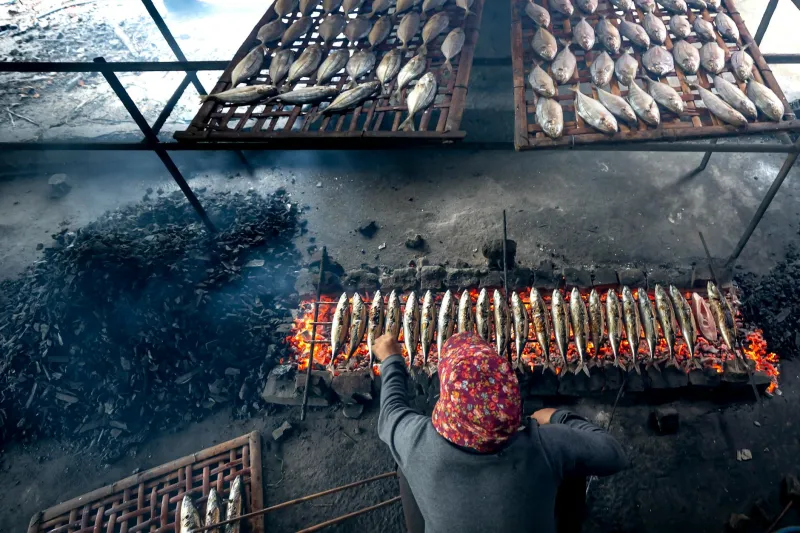
Step into L. Robson & Sons in Craster on a misty Northumberland morning, and you'll understand immediately why industrial fish processing will never capture what these family smokehouses offer. The air itself tells a story—layers of oak smoke, salt spray, and time itself seem woven into the very walls. This is where herrings become kippers through a process unchanged since the Victorian era, where each fish is split by hand and hung with the precision that only comes from generations of inherited knowledge.
Yet walk these same cobbled streets in another decade, and you might find only memories where the smoke once rose.
The Dying Art of Fire and Time
Britain's traditional smokehouses are disappearing at an alarming rate. What once numbered in the hundreds across our coastal communities has dwindled to fewer than thirty authentic operations still using traditional methods. The reasons are predictably modern: supermarket contracts that demand industrial quantities, health regulations that favour sterile factory conditions over centuries-old techniques, and perhaps most crucially, a generation gap that threatens to break the chain of knowledge forever.
In Arbroath, where the famous 'smokie' haddock earned protected designation status, only a handful of family curers remain. The Spink family, whose smokehouse has operated for over a century, still fires their pits with silver birch and oak, creating the distinctive flavour that made Arbroath smokies legendary. Yet even they struggle against imported alternatives that bear the same name but lack the soul.
Regional Timber, Regional Character
What sets Britain's traditional smokehouses apart isn't just technique—it's terroir. Each region developed its smoking methods around locally available materials, creating distinctive flavour profiles that reflect the landscape itself.
In the Scottish Highlands, salmon curers traditionally used peat and juniper, imparting an almost whisky-like complexity to the fish. The cold, clean air of the Highlands slows the curing process, allowing flavours to develop gradually. Meanwhile, in East Anglia, the preference for apple and cherry wood from ancient orchards creates a sweeter, more delicate smoke that complements the region's renowned bloaters.
The Yorkshire coast developed its own tradition around alder wood, prized for its ability to produce a steady, cool smoke perfect for the region's famous oak-smoked salmon. These weren't arbitrary choices—they were the result of centuries of experimentation, passed down through families who understood that the marriage of local wood, local fish, and local climate created something irreplaceable.
The Hands That Know
At Fortune's Smokehouse in Whitby, eighty-year-old Frank Fortune still arrives before dawn to tend fires that have burned continuously for three generations. His hands move with unconscious precision as he selects each herring, feeling for the oil content that will determine smoking time. This isn't knowledge you can learn from textbooks—it's intuition built from handling thousands of fish, understanding how weather affects the cure, knowing by scent alone when the smoke is perfectly balanced.
"My grandfather taught me that every fish has its own personality," Frank explains, adjusting the height of a kipper rack with practised ease. "Mass production treats them all the same. That's why they all taste the same."
This personalised approach extends to every aspect of traditional smoking. The salt used isn't the refined product of industrial processing but coarse sea salt, often from local sources. The timing isn't determined by factory schedules but by the fish themselves, the weather, the season. A true smokehouse master reads conditions like a sailor reads wind—constantly, instinctively, with respect for forces larger than themselves.
What Dies With the Fires
When a traditional smokehouse closes, we lose more than a business—we lose a library of knowledge that took centuries to compile. The understanding of how different woods burn at various temperatures, how humidity affects curing times, how to judge doneness by colour and texture rather than thermometers and timers.
We also lose biodiversity in our food system. Industrial smoking produces uniformity, but traditional methods celebrate the variations that come with seasonality, locality, and craftsmanship. Spring herrings smoke differently than autumn ones. Fish caught in different waters require different approaches. This complexity, this connection to natural rhythms, disappears when production moves to climate-controlled factories.
The Economics of Authenticity
The harsh reality facing Britain's remaining smokehouse families is economic. A traditional kipper that takes days to cure properly cannot compete on price with factory-smoked alternatives produced in hours. Supermarket buyers, focused on consistent supply and rock-bottom prices, often cannot distinguish between authentic craftsmanship and industrial imitation.
Yet there are signs of hope. The growing interest in provenance and traditional foods has created a market willing to pay premium prices for authenticity. Restaurants celebrating British cuisine seek out genuine smokehouses, understanding that their products cannot be replicated by industrial methods.
Preserving the Smoke
Several initiatives are working to preserve this endangered craft. The Smokehouse Guild, formed by remaining traditional curers, shares knowledge and lobbies for recognition of their methods' cultural importance. Apprenticeship schemes attempt to interest younger generations in learning these ancient skills, though success remains limited.
Perhaps most importantly, consumers are beginning to understand what they stand to lose. The difference between a factory-smoked salmon and one cured over Highland peat isn't subtle—it's profound. One is a product; the other is edible heritage.
The Future of Smoke
Britain's traditional smokehouses represent something increasingly rare in our modern food system: genuine connection to place, season, and craft. They embody the slow food movement's ideals not as trendy philosophy but as practical reality, inherited from ancestors who understood that good food cannot be rushed.
As we stand at this crossroads, the choice is ours. We can allow these fires to die out, accepting that convenience and cost matter more than craftsmanship and culture. Or we can recognise that in preserving these smokehouses, we preserve something essential about British food culture—the understanding that the best flavours come not from factories but from human hands, local materials, and time itself.
The smoke may be fading, but the stories it tells are too valuable to lose forever.