The River's Ancient Rhythm
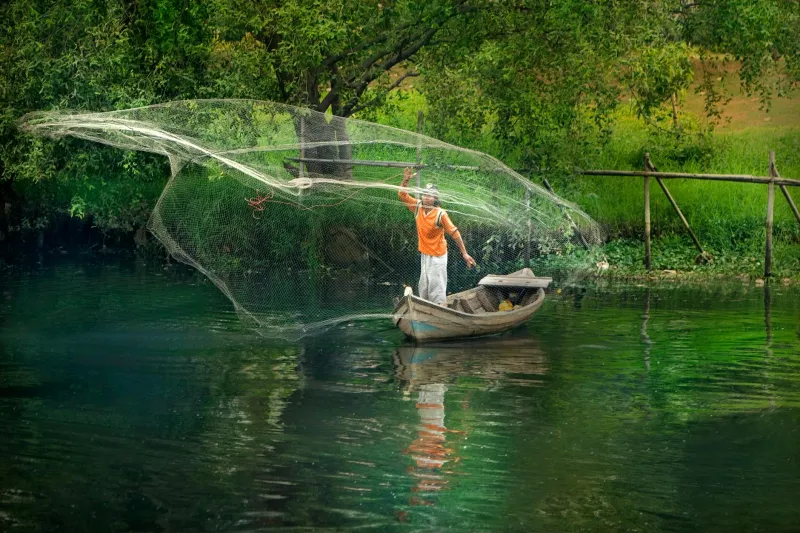
In the grey light of dawn, Malcolm Jenkins wades into the Severn's chocolate-coloured waters, his Y-shaped lave net cutting through the current like a prayer made manifest. At 73, he's one of just twelve licensed lave net fishermen left on Britain's longest river, guardians of a technique that predates the Roman invasion by centuries.
The lave net itself looks deceptively simple—a triangular frame of ash or willow, strung with hand-knotted mesh, mounted on a long pole. Yet mastering its use requires decades of intimate knowledge: reading the river's moods, understanding salmon behaviour, knowing precisely where to position oneself in the treacherous tidal flow.
"My grandfather taught me to read the water like a book," Jenkins explains, adjusting his stance as the incoming tide shifts the current. "Every ripple tells a story. Every shadow might hide a fish."
Threads of Time
Archaeological evidence suggests lave netting has been practised on the Severn for over 2,000 years. The technique appears in medieval documents, survived the Industrial Revolution's pollution, and weathered two world wars. UNESCO recognised it as an Intangible Cultural Heritage in 2016, yet this ancient craft now faces its greatest threat: the simple mathematics of extinction.
Where once hundreds of men worked the Severn's tidal reaches from Gloucester to the Bristol Channel, today's practitioners can be counted on two hands. The youngest is approaching retirement; the oldest remembers when salmon runs were so thick you could "walk across their backs."
The salmon themselves tell the story of decline. Atlantic salmon numbers in the Severn have crashed by over 90% since the 1970s. Climate change, river modifications, and marine survival issues have reduced what was once a torrent of silver to a trickle. Many lave netters now go entire seasons without landing a single fish.
More Than Method
To understand what's at stake, one must appreciate that lave netting represents far more than a fishing technique. It's a living library of ecological knowledge, passed down through generations of riverside families. These men don't just catch salmon—they serve as the river's memory keepers, chronicling changes in water quality, fish behaviour, and seasonal patterns that scientific monitoring often misses.
"We know every stone on this riverbed," says Peter Davies, whose family has worked these waters for five generations. "We can tell you which pools fish favour in different weather, how the tides affect their movement, where they rest before making their spawning run upstream."
This knowledge extends beyond the water. Lave netters traditionally crafted their own equipment, selecting wood during specific lunar phases, understanding which trees grew in which soil conditions. They developed an intimate relationship with their local landscape that modern conservation efforts struggle to replicate.
The Weight of Heritage
UNESCO recognition brought welcome attention but little practical support. Heritage status cannot conjure salmon from depleted waters or convince young people to take up a profession that might yield no income for years. The designation feels increasingly like a museum label on a living practice that's slowly suffocating.
Current regulations require lave netters to release any salmon they catch, transforming them from fishermen into unpaid research assistants. While conservation necessity drives this policy, it removes the final economic incentive for new practitioners to learn the craft.
"We're not asking to decimate the runs," Davies emphasises. "But when you can't even keep a fish for your own table after a lifetime of learning, what's the point of passing on the knowledge?"
Lessons from the Tide
The Severn lave netters embody a broader tension in modern Britain between conservation and tradition. Their plight mirrors that of other heritage practices—from dry stone walling to traditional coppicing—that struggle to maintain relevance in contemporary society.
Yet their story also illuminates possibilities. Some fishermen now work with researchers, their traditional knowledge informing scientific studies. Others engage in educational programmes, teaching school groups about river ecology and sustainable fishing practices. A few have found ways to monetise their expertise through guided experiences and heritage demonstrations.
The Final Cast
As evening approaches, Jenkins prepares for his final cast of the day. The tide is turning, and salmon—if any are running—will be moving with it. He positions his net with practised precision, reading currents invisible to untrained eyes.
The net comes up empty, as it has for weeks. But Jenkins shows no frustration, only the quiet acceptance of a man who understands that some things transcend immediate reward.
"I'll keep coming until I can't wade anymore," he says, shouldering his ancient tool. "Someone needs to remember how it's done. Someone needs to keep faith with the river."
Whether that faith can sustain a 2,000-year-old tradition remains the Severn's secret. But as long as men like Malcolm Jenkins wade into its waters, the ancient rhythm continues, each cast a defiant act of hope against the dying of an irreplaceable light.