When Darkness Falls on the Water
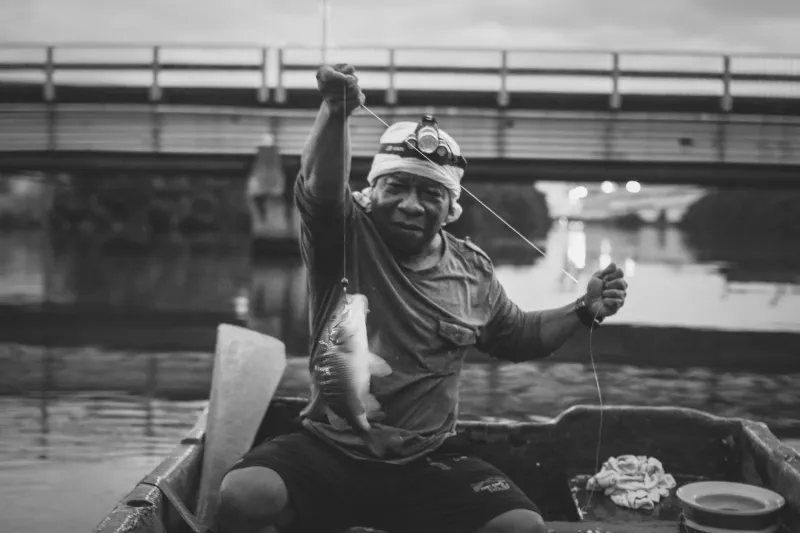
The old man wades knee-deep into the Usk, his carbide lamp casting dancing shadows across the black water. Behind him, forty years of night fishing experience guides every step, every subtle shift of the hand-net that's been in his family since his grandfather's time. This is lamping — Britain's most atmospheric and least understood fishing tradition.
"People think we're poaching," chuckles Dai Evans, adjusting the flame on his brass lamp. "But this is older than most of the laws they've written about it." He's one of perhaps two dozen practitioners left in Wales who still work the rivers after dark, pursuing eels, trout, and whatever else moves in the lamp's golden circle of light.
The technique itself is deceptively simple. A bright light — traditionally a carbide or oil lamp, though some modern practitioners use powerful torches — attracts fish in the darkness. Working in pairs, one person holds the light steady whilst the other manoeuvres a large landing net beneath the mesmerised fish. It requires extraordinary skill, infinite patience, and an almost supernatural understanding of how water moves in the dark.
The Legal Labyrinth
Lamping exists in Britain's regulatory grey areas, a twilight zone as murky as the waters these fishers work. Whilst the practice isn't explicitly illegal on many rivers, it falls under a patchwork of local bylaws, fishing rights, and environmental protections that vary dramatically from one stretch of water to the next.
"The law's never caught up with what we do," explains Margaret Thompson, who learned the craft on Northumberland's rivers in the 1970s. "We're not commercial fishers, we're not sport anglers. We're something else entirely — something the bureaucrats don't quite know how to categorise."
This ambiguity has both protected and persecuted the tradition. Some riparian owners welcome skilled lampers, recognising their intimate knowledge of fish populations and river health. Others view any nocturnal activity with deep suspicion, particularly in areas where salmon poaching remains a genuine concern.
A Different Kind of Knowledge
What sets true lampers apart is their extraordinary intimacy with Britain's waterways. These are people who know which pools hold fish on moonless nights, who can read the subtle changes in water temperature that signal a good evening's work, who understand the complex relationship between weather patterns and fish behaviour in ways that daylight anglers rarely achieve.
"You learn the river's personality in the dark," says Evans, whose family has worked the Usk for three generations. "Every sound means something — the splash of a rising fish, the way water moves over stones, even the silence when everything goes still. It's like speaking a different language."
This knowledge once fed entire communities. Before refrigeration and modern transport networks, the ability to catch fresh fish throughout the year was crucial for rural food security. Lamping provided protein during winter months when other fishing methods proved less reliable, and the eels caught using these techniques formed the backbone of countless traditional recipes.
The Next Generation
Today, a small but dedicated group of younger practitioners is working to keep lamping alive. They're drawn by the craft's meditative qualities, its deep connection to place, and its role in sustainable food production. Unlike industrial fishing or intensive aquaculture, lamping takes only what the river offers, leaving minimal environmental impact.
"There's something profound about working with your hands in the dark," reflects James Morrison, a 32-year-old chef who learned lamping from his grandfather in the Scottish Borders. "In a world of LED screens and constant noise, this connects you to something much older and more fundamental."
Morrison represents a new breed of lamper — university-educated, environmentally conscious, and deeply committed to understanding the ecological implications of their practice. They work closely with local fisheries officers, maintain detailed catch records, and often contribute valuable data to river management programmes.
Rivers in the Balance
The revival of lamping coincides with growing concerns about the health of Britain's rivers. Climate change, agricultural runoff, and urban development have dramatically altered freshwater ecosystems, making the traditional knowledge of lampers increasingly valuable for conservation efforts.
"These old-timers know things about our rivers that science is only beginning to understand," argues Dr Sarah Williams, a freshwater ecologist at Cardiff University. "Their observations about fish behaviour, population changes, and environmental shifts represent decades of detailed, localised knowledge that we can't afford to lose."
Some rivers that once supported thriving lamping communities now struggle to maintain viable fish populations. The chalk streams of Hampshire, the limestone rivers of Yorkshire, and the acidified waters of Wales tell different stories of environmental change, each reflected in the experiences of local lampers.
The Lantern's Last Light
As Evans packs away his equipment at the end of another evening on the Usk, the future of lamping remains uncertain. The combination of regulatory pressure, environmental challenges, and simple demographic change threatens to extinguish this ancient practice within a generation.
Yet there's hope in the dedication of practitioners like Morrison and Thompson, who see lamping not as a relic of the past but as a vital connection to sustainable food production and river stewardship. Their work suggests that Britain's twilight fishing tradition might yet survive, carrying forward centuries of accumulated wisdom about our waters and the life they sustain.
The lamp may flicker, but it hasn't yet gone out.