The tide is turning, literally and figuratively, for one of Britain's most extraordinary fishing traditions. As dawn breaks over the Solway Firth, where Scotland meets England in a sprawling expanse of mud flats and tidal channels, a small group of men prepare for what their Viking ancestors would recognise instantly.
Standing Where Vikings Once Stood
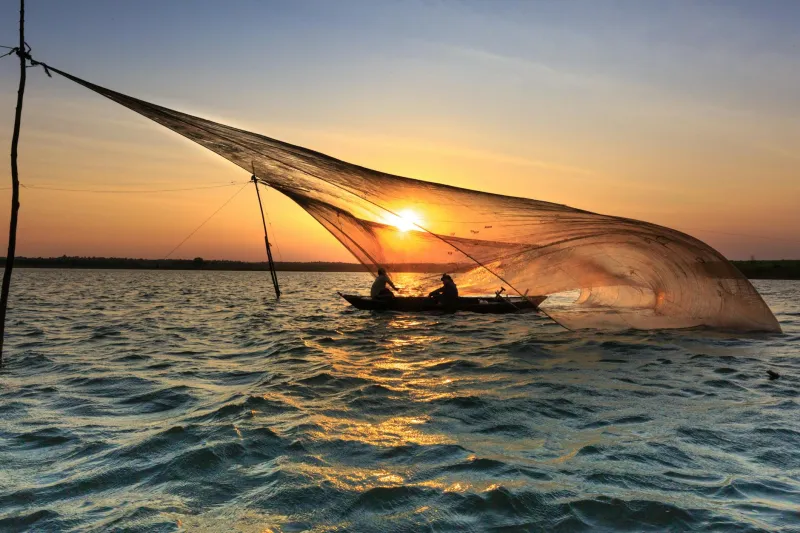
Haaf netting – from the Old Norse 'haf' meaning sea – requires fishermen to wade chest-deep into treacherous tidal waters, wielding enormous fixed nets that can span eighteen feet. The technique hasn't changed since Norse settlers first established it over a millennium ago. Yet today, fewer than a dozen practitioners remain across the entire Solway region, making this arguably Britain's rarest surviving food tradition.
The nets themselves are works of art – handcrafted wooden frames strung with mesh, designed to catch salmon as they navigate the estuary's complex currents. Each fisherman must read the water like an ancient text, understanding precisely where to position themselves as thousands of gallons surge past every second.
"You're not just fishing," explains Donald McKenzie, whose family has worked these waters for six generations. "You're entering into conversation with forces that shaped this coastline before Britain even existed. The Vikings knew these currents, and so did my great-grandfather. But I wonder if my grandson ever will."
The Weight of Water and Bureaucracy
The physical demands are extraordinary. Haaf netters must maintain their position against powerful currents whilst manipulating nets that become exponentially heavier when laden with fish. The margin for error is non-existent – a misplaced step or moment's inattention can prove fatal in waters that have claimed numerous lives over the centuries.
Yet the greatest threat isn't the Solway's notorious bore tides or shifting sands. It's paperwork.
Modern licensing requirements have created bureaucratic barriers that would bewilder the tradition's Viking founders. Multiple agencies oversee different aspects of the practice, from environmental impact assessments to health and safety protocols. The irony isn't lost on practitioners that a technique which sustained communities for centuries now struggles to satisfy contemporary regulatory frameworks.
"We're asked to prove things that our ancestors took for granted," says James Bell, one of the youngest haaf netters at just forty-three. "How do you quantify knowledge passed down through generations? How do you measure the value of understanding that exists nowhere else?"
When Living Heritage Dies
The decline in fish stocks presents another existential challenge. Climate change, agricultural runoff, and industrial development have dramatically reduced salmon numbers throughout British waters. For haaf netters, this creates a cruel paradox – their sustainable, selective fishing method becomes economically unviable precisely when such approaches are most needed.
Dr Sarah Morrison from the Institute for Rural Heritage Studies argues that Britain is witnessing the quiet extinction of irreplaceable knowledge systems. "When the last haaf netter hangs up their net, we lose more than a fishing technique. We lose a thousand years of accumulated wisdom about reading water, understanding weather patterns, and living in harmony with natural cycles."
The cultural implications extend beyond fishing. Haaf netting represents a direct link to Britain's Norse heritage, preserved not in museums but in the lived experience of working people. The technique embodies principles of sustainability that modern environmentalists are only beginning to articulate – selective harvesting, intimate knowledge of ecosystems, and practices that work with rather than against natural systems.
Fighting the Current
Some heritage organisations are beginning to recognise what's at stake. The Scottish Traditional Fishing Heritage Trust has started documenting techniques and supporting remaining practitioners, whilst food culture advocates argue for recognition of haaf netting within broader discussions about sustainable fishing.
However, meaningful support requires more than documentation. Practitioners need simplified licensing processes, protection for traditional fishing grounds, and acknowledgement that some forms of heritage deserve preservation for their intrinsic value rather than their economic output.
"We're not asking for special treatment," McKenzie emphasises. "We're asking for understanding that some traditions are worth preserving because they represent the best of human adaptation to natural environments. Our ancestors survived here for centuries using these methods. Surely that's worth something in an age of environmental crisis."
The Tide's Last Turn
As consumer interest in provenance and sustainability grows, haaf-caught salmon should represent the ultimate in responsible sourcing. These fish are individually selected from wild populations using methods that predate industrial fishing by centuries. Yet most consumers remain entirely unaware that such practices exist.
The challenge facing haaf netting reflects broader questions about Britain's relationship with its rural heritage. In an increasingly urbanised society, do we value traditions only when they can be commodified for tourism, or do we recognise that some practices deserve support simply because they represent irreplaceable human knowledge?
For the handful of men still wading into the Solway's ancient waters, time is running out. Each tide could be among the last to witness a technique that survived Viking raids, Border conflicts, and two world wars. Whether it survives the indifference of modern bureaucracy remains to be seen.
The answer may determine not just the fate of haaf netting, but Britain's commitment to preserving the living heritage that once defined our relationship with the land and sea that sustained us.